Ancient sight
The carvings
Marks Park and North Bondi
- WhereHeadland rock shelves
- Look forSea creatures, boomerang
- RuleNever walk on them
Guides
Language
Currency
Find a datestarting at $107 · free cancellationSpot your stop
Discover 20 stops
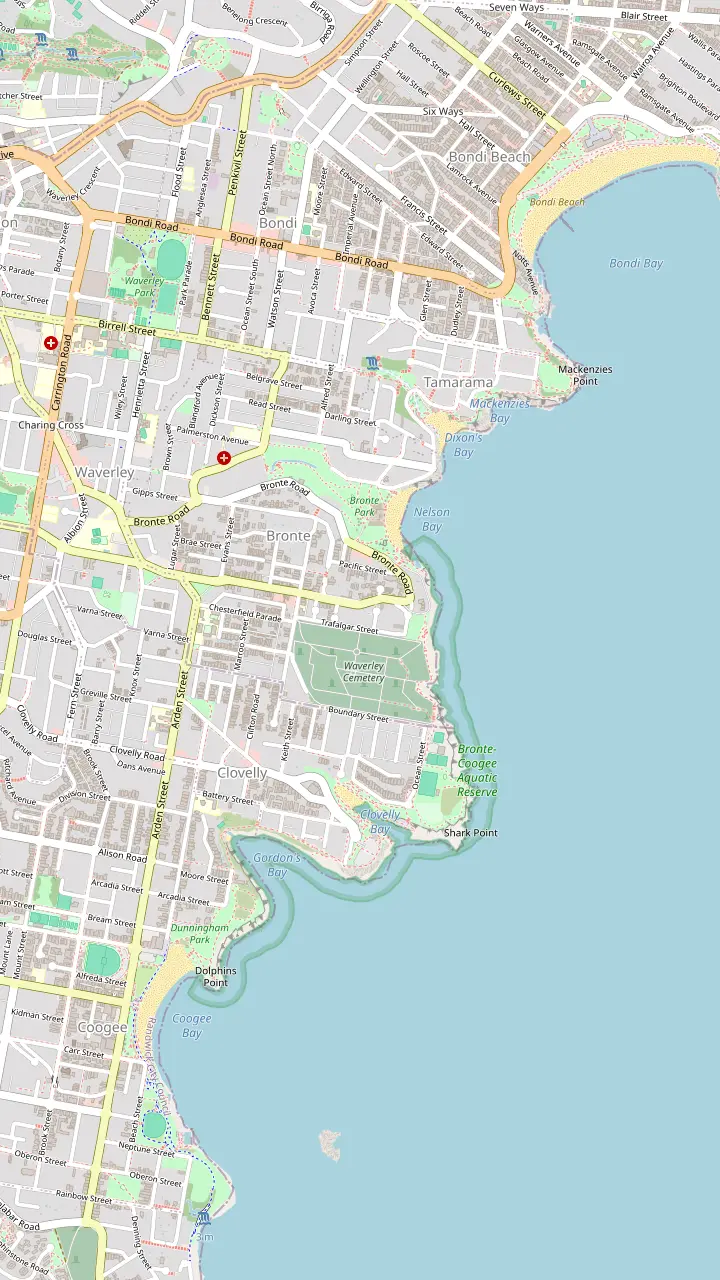
First pick a route, then tap any pin or stop for details and Google Maps.
The ocean pool at the south end of the beach, open to the public all year, with lifeguards on duty while it is open.
Google MapsThe grassy headland south of Mackenzies Point, with Aboriginal rock carvings beside the path; never step on them.
Google MapsThe first beach south of Bondi on the coastal walk, with public toilets and a drinking fountain.
Google MapsA heritage ocean pool built in 1887 on the southern rocks of Bronte, beside the Bogey Hole rock pool.
Google MapsHeritage-listed clifftop cemetery where Henry Lawson, Dorothea Mackellar and Lawrence Hargrave lie.
Google MapsA sheltered narrow inlet in the Bronte-Coogee Aquatic Reserve, with ladders into calm water for snorkelling.
Google MapsA small bay lined with fishing boats, with a 600-metre underwater nature trail.
Google MapsThe south end of the coastal walk, sheltered by Wedding Cake Island, with buses stopping beside the sand.
Google Maps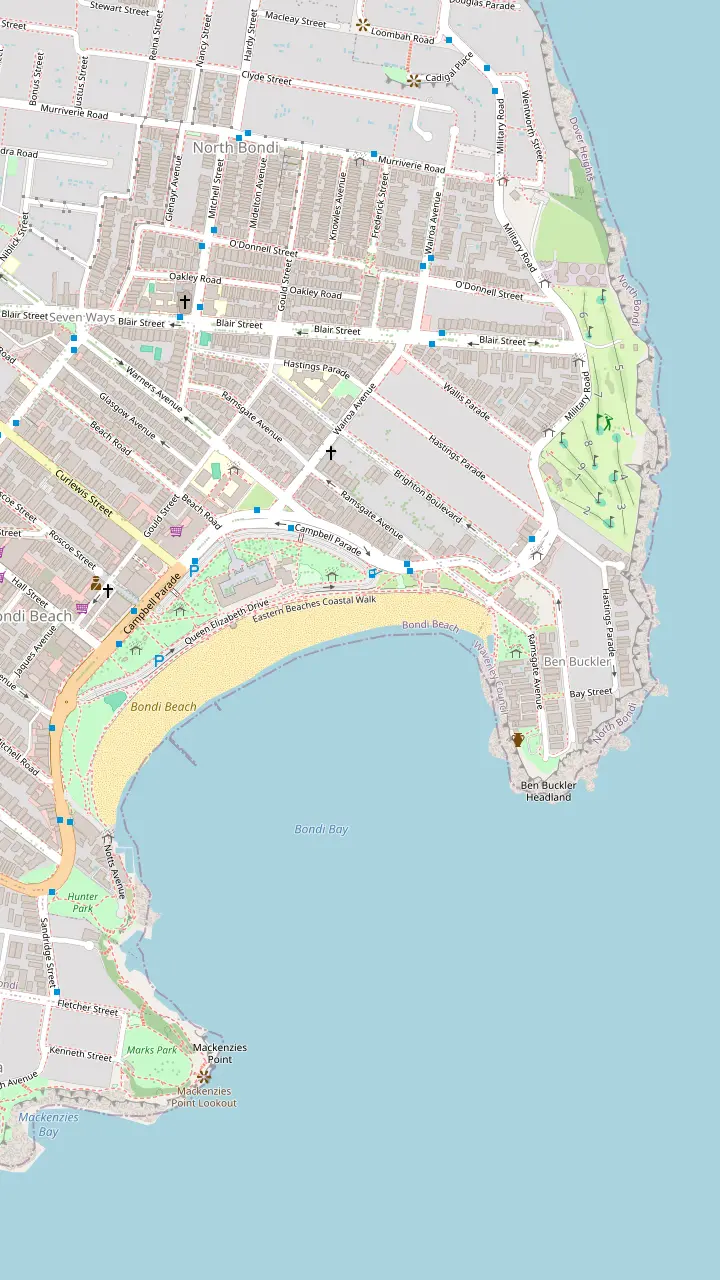
The ocean pool at the south end of the beach, open to the public all year, with lifeguards on duty while it is open.
Google MapsInter War Mediterranean pavilion behind the sand, opened on 21 December 1929.
Google MapsHome of the Bondi Surf Bathers' Life Saving Club, founded in 1907.
Google MapsAboriginal engravings on the golf course rocks: the visible group shows a seal, a shark, fish and a boomerang.
Google MapsThe northern headland, where one of only 3 disappearing gun batteries in Sydney lies under the grass.
Google MapsBondi Beach Public School grounds: farmers market on Saturdays, Bondi Markets on Sundays.
Google MapsThe surf school at the northern end of the beach, where the 2-hour group lesson meets.
Google MapsThe ocean pools at the northern end, which Destination NSW suggests for younger children.
Google Maps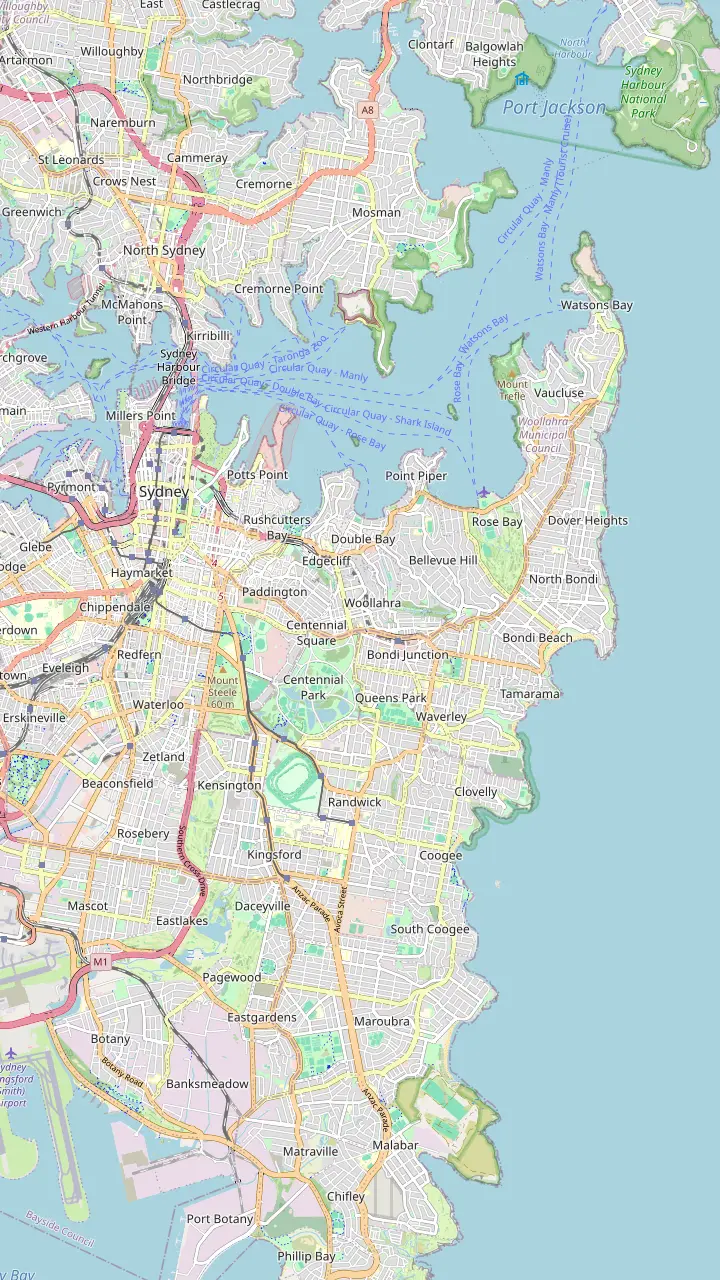
City station: Bondi is about 30 minutes from here by public transport.
Google MapsCoogee is about half an hour by public transport from Central Station.
Google MapsFrom Circular Quay, buses reach Bondi via Bondi Junction and Coogee via the city centre.
Google MapsTake the train here, then a bus to the beach; buses also run to Bronte and Coogee.
Google MapsAbout 1.5 km of sand between Ben Buckler and Mackenzies Point.
Google MapsThe south end of the coastal walk, sheltered by Wedding Cake Island, with buses stopping beside the sand.
Google MapsMaps © OpenStreetMap contributors
The path is the frame; the cliffs, the carvings in the rock, a cemetery above the sea and a spring sculpture show are the pictures. Here is what to look for, where it is, and when it is at its best.
Editorial team, bondibeachtour.com · Updated November 8, 2026 · Quick read: 8 min
Everything on this walk starts with the rock. The path runs for 6 km along sandstone cliffs, cut into them in places, with the ocean open in front of you the whole way.1 The Bondi to Coogee coastal walk cliffs are not one wall but a series of headlands and bays, so the view changes every few minutes: a beach, a point, a pool, then another beach. That rhythm is why the route photographs so well.
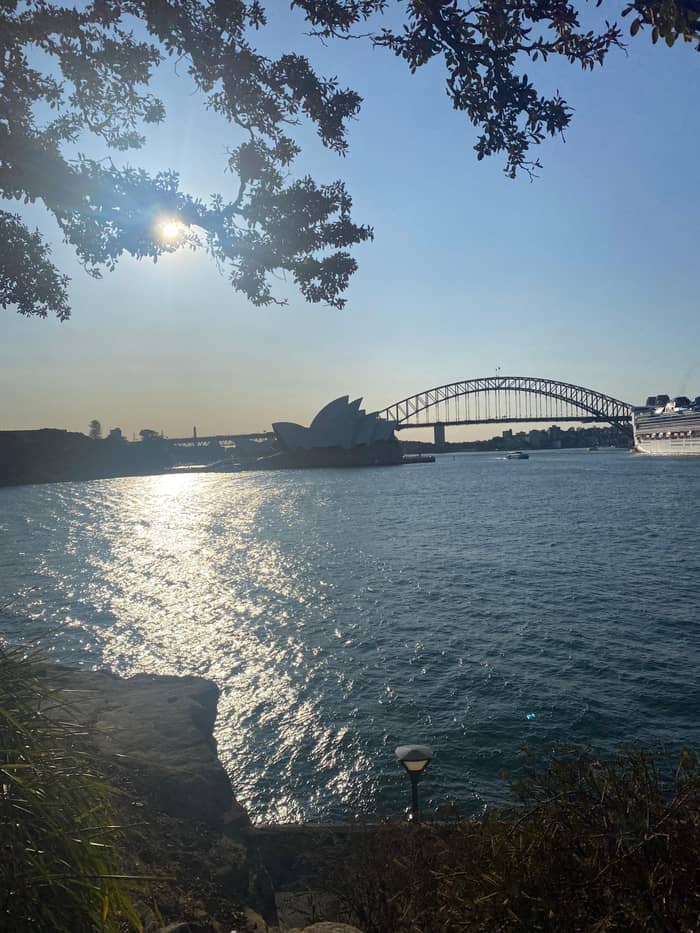
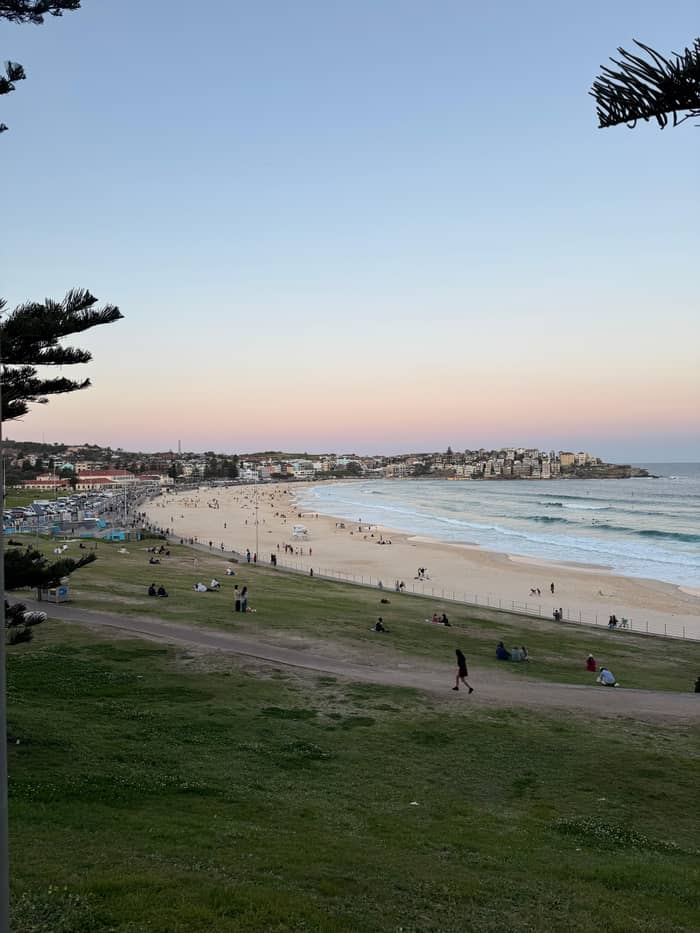
Bondi itself sits between a pair of these headlands, Ben Buckler to the north and Mackenzies Point to the south.7 Walk out onto the southern one and you get the classic picture of the whole beach in a curve, with the city behind it. According to the National Heritage listing the beach stretches about 1.5 km and is more than 100 m wide, sitting in a basin between those sandstone headlands; from the point you can see why.8
Sandstone is soft rock, and the council library notes that the stone of this coast is relatively easy to work, which is why people carved into it and why those carvings fade.9,10 Look down as well as out: on the flat rock shelves you will see honeycomb patterns, pools left by the tide and, in a few places, much older marks made by people. Stay on the path near the edges, since the rock crumbles and the drops are real. After rain the sandstone turns dark and slick, and the shelves near the water stay wet long after the path has dried.
Plan your shots
| Spot | Subject | Best time | Note |
|---|---|---|---|
| Mackenzies Point | Whole arc of Bondi | Early morning | Southern headland |
| Marks Park | Carvings and whales | Winter mornings | Do not step on the rock |
| Bondi to Tamarama | Sculptures | Spring weekdays | Free, no tickets |
| Waverley Cemetery | Headstones and sea | Low light | Quiet, respectful |
| Gordons Bay | Boats on the sand | Calm days | Many stairs |
| Dolphin Point | Wedding Cake Island | Any clear day | Bali memorial |
Places from Destination NSW and the Waverley Council library; sculpture dates change each year, so check the organisers.2,4,13
This coast is part of the country of the Bidjigal, Birrabirragal and Gadigal people, and the council library lists carvings on the North Bondi golf course, at Ben Buckler Reserve and on the path at Mackenzies Point as important Aboriginal places.14,15 At Marks Park, just south of Mackenzies Point, Destination NSW describes the carvings beside the path as 2,000-year-old work.2 They are easy to walk straight past, so slow down on the grass and look at the flat rock near the path.
The library explains how such engravings were made: the outline of a figure was pecked into the rock as a line of holes, which were then joined.16 It also records that engravings held bodies of cultural knowledge and are sometimes called our classrooms today.17 At North Bondi there are 2 large groups on the flat rocks of the golf course; the visible northern group shows a seal, a shark, fish of several sizes and a boomerang.3,18
Some of what you see has been altered. The council fenced the northern group in 1933 and had a stonemason recut the fading grooves in 1951 and 1964, and the library says some figures were not traced exactly or by traditional methods.19 However faint they look, these remain sacred places: the council asks that no one walk on or touch any engraving.20 Photograph from the edge and leave the rock as you found it.
Sights in walking order
Mackenzies Point
The southern headland of the beach.7
Marks Park
Aboriginal carvings sit beside the path.2
Bondi to Tamarama
More than 100 works on 2 km of clifftop.4
Bronte
An ocean pool on the rocks, built in 1887.11
Waverley Cemetery
Heritage-listed, on the clifftop.12
Dolphin Point
A lookout over Giles Baths and the island.13
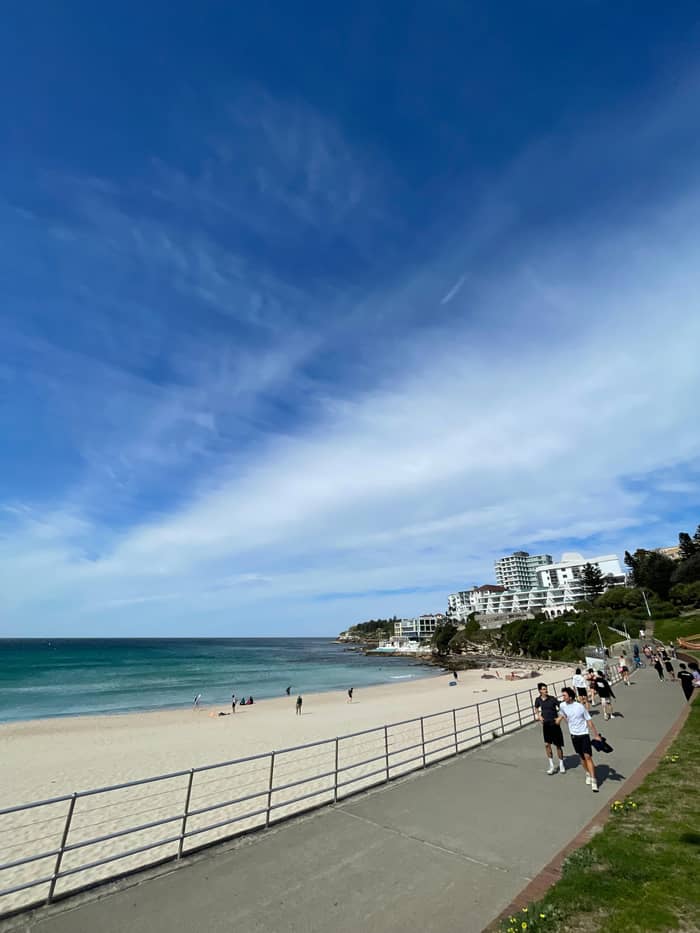
For a few weeks each spring the Bondi to Coogee walk sculptures are the main event. Sculpture by the Sea puts more than 100 works along 2 km of clifftop between the southern end of Bondi Beach and Tamarama, and Destination NSW calls it the largest free outdoor sculpture exhibition in the world.4,24 It is free, and no tickets or bookings are needed.25,26 The works change every year, from huge steel forms on the rocks to small pieces you could walk past, so each show is a new reason to come back.
In 2026 it ran from 16 October to 2 November, its 30th year, with up to half a million visitors expected over the run.24,27 The organisers have announced 22 October to 8 November for the 2027 show at Bondi, and ask visitors to check with their office before making travel plans.21 Outside those weeks the clifftop is empty again, so if the art matters to you, plan the trip around it. The dates move a little from year to year, which is why the organisers' own page is the one to check.
Crowds are the catch. The tourism board says weekends are generally very busy and suggests a weekday visit to avoid the crush.28 A free app guides you through the works, with a map and details about each piece.29 Early morning on a weekday is when you can photograph a sculpture with the sea behind it and nobody in front of it. Late afternoon is the other good window, when the light turns warm and the walkers thin out.
Pick your focus
Find the sight you care about most and the time to come.
If I want to see the sculptures
Come in late October
The 2027 show is announced for 22 October to 8 November.21
If I want whales
Come in late June or July
Those are the peak months for sightings.22
If I want calves close to shore
Come in October or November
Mothers and calves swim down the coast then.23
If I want the carvings in quiet
Walk early
Marks Park sits on the busiest first stretch of the walk.2
If I want the cemetery views
Allow extra time
You can walk past it on the coastal path or through it.12
Reasons to slow down
Ancient sight
Marks Park and North Bondi
Spring only
Bondi to Tamarama
Winter and spring
From every headland
From May to November the walk becomes a whale lookout.52 Destination NSW says around 40,000 humpback whales pass the Sydney coast each year on their migration from Antarctic waters to the warmer Pacific.5 The headlands on this route, Marks Park and Dolphin Point above Coogee among them, give you height and a wide view of the sea.53 Pick a spot with a clear horizon and a bench or a ledge, because the whales do not keep a timetable and patience pays.
Timing helps. The peak months for sightings are the end of June and the beginning of July, as the whales head north.22 In October and November mothers and calves come back down the coast, often closer to shore.23 The tourism board lists the clifftop trails from Bondi to Coogee among its recommended places to watch from land.54 Watching from the cliffs is free and needs nothing more than a spare morning.
Whale watching from a cliff is mostly waiting. Look for the blow first, a puff of spray that hangs above the water, then watch the same patch for a back or a tail. Wear warm clothes and bring something to sit on if you plan to stay in one spot; the board suggests a blanket for the colder months.55 Binoculars and a zoom lens make the difference between a dot and a photograph. Calm days are best, since whitecaps on a windy sea look very like a blow.
Between Bronte and Clovelly the path runs past a strikingly placed burial ground. Waverley Cemetery is heritage-listed and spreads across the clifftop, rows of white headstones with nothing beyond them but ocean.12 You can walk past on the coastal path or wander through it on the cemetery's own paths. The upper paths are steeper, but they give the best views over the headstones to the sea and back north towards Bronte.
It is the resting place of many prominent Australians. Destination NSW picks out the literary figures Henry Lawson and Dorothea Mackellar, along with Lawrence Hargrave, a pioneer of aviation.6 For a photographer the appeal is the contrast: carved angels, iron railings and weathered stone against a flat blue horizon, especially in the low light of early morning or late afternoon. A wide lens takes in the rows of graves and the ocean in one frame; a longer one picks out single angels against the sky.
Remember that it is still a cemetery. Keep your voice down, do not climb on monuments, and give space to anyone visiting a grave. Shoot the setting rather than individual headstones with family names on them, and keep drones away. Treat it as a place of rest first and a view second, and it rewards you with some of the quietest minutes on the walk. Many walkers rush past without looking, so even on a busy day you may have it almost to yourself.
Video
TravelByTy on YouTube · Nothing is fetched until you hit play.
Rock engravings were a common way to capture bodies of cultural knowledge and sometimes referred today as "our classrooms".
For a good photo walk
The pools are the signature images of this coast. At Bondi the Icebergs pool sits right where the waves break, and the tourism board calls it one of the most photographed pools in Australia.56 Bronte Baths, built in 1887, sits on the southern rocks of Bronte beside the Bogey Hole.11 At Coogee, Ross Jones Memorial Pool has walls shaped like sandcastle turrets, and Wylie's Baths has a raised timber deck over the sea.57
The bays give quieter pictures. Clovelly is a narrow inlet lined with concrete platforms, and Gordons Bay is a small beach with fishing boats drawn up on the sand.58,35 Dolphin Point, the headland at the northern end of Coogee, gives a view across Giles Baths to Wedding Cake Island; a bronze memorial there honours the local people who died in the Bali bombings of 2002.13 It is one of the best viewpoints at the Coogee end, and a fitting place to stop for a moment before the last stretch down to the beach.
For Bondi to Coogee walk photos, the best light is early. The coast looks east over open ocean: in the first hour of the day the light comes in off the water and falls straight onto the cliffs and pools. Midday flattens everything and fills the frame with people. If you can only come once, come at sunrise, walk south, and stop at the headlands rather than the beaches for the widest shots.
FAQ
Destination NSW places traditional Aboriginal rock carvings at Marks Park, just south of Mackenzies Point.2
Waverley's library asks that nobody steps on or handles them, as they are still culturally significant.20
Sculpture by the Sea is free and needs no tickets or bookings.26
They include Henry Lawson, Dorothea Mackellar and Lawrence Hargrave.6
The tourism board ranks it among the pools most often photographed in the country.56
Sources
Planning a Bondi day? Ask a real person here.